
Mentions & Citations by Competitors
Track your competitors' AI visibility using the Mentions by Competitors and Citations by Competitors lists sorted by volume
Who dominates your category by mentions and source authority?
Right below the KPI tiles, you'll find two top-10 lists: on the left Mentions by Competitors, on the right Citations by Competitors. Both show you who in your category is currently collecting the most AI touchpoints, sorted by absolute volume.
In this article, you'll learn how these lists are structured, what mentions and citations each tell you, and how to read them together.
What you'll find in this article 👇
-
Mentions by Competitors
-
Citations by Competitors
-
Mentions vs Citations as different stories
-
Identifying your own competitive set
-
Full brand table from Show data table
-
Best practices
Mentions by Competitors
The left list shows the ten brands with the most mentions in your currently selected filter scope.
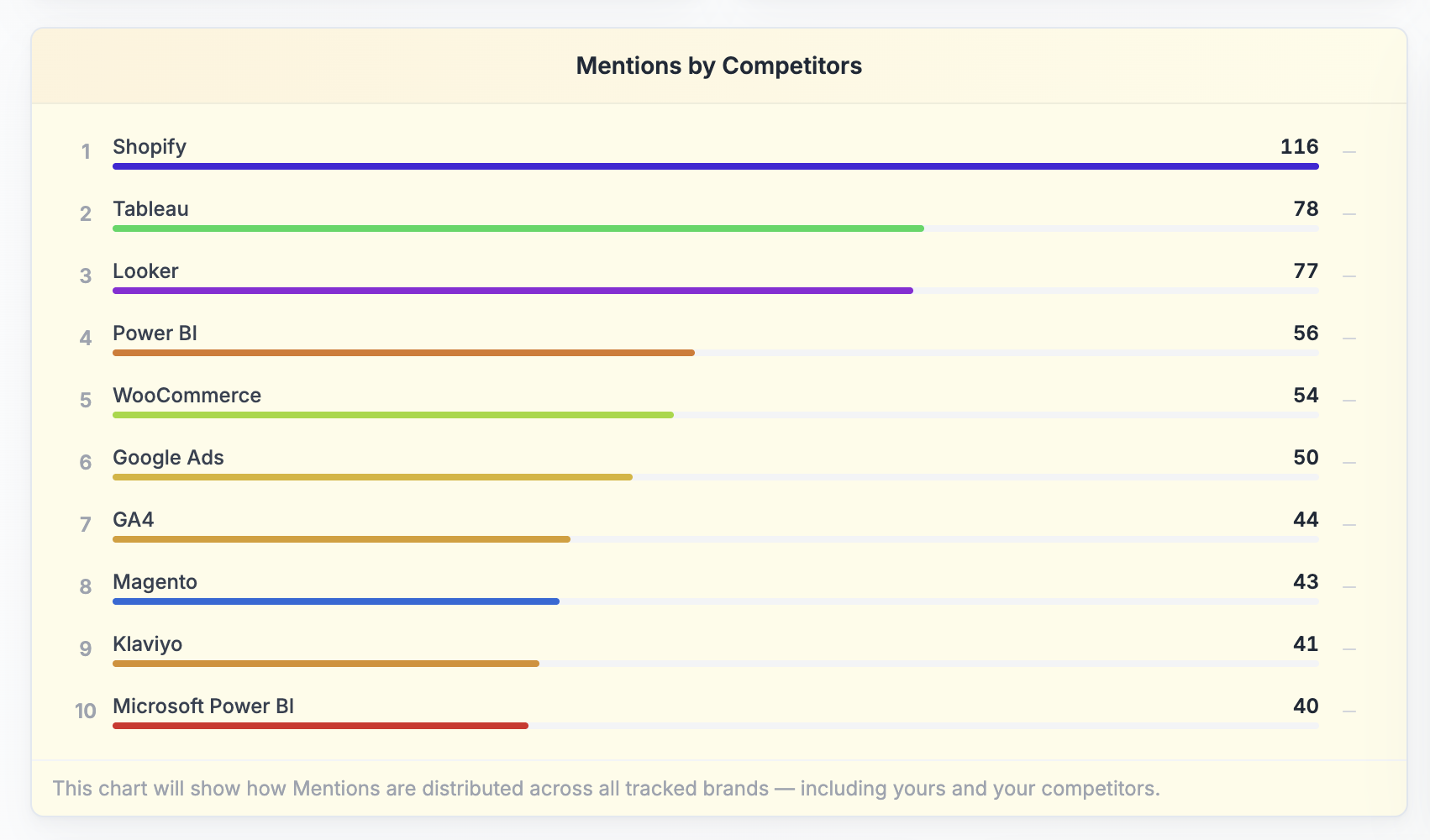
Each entry consists of:
- Rank (1 to 10)
- Brand name
- Bar visualization in brand-specific color
- Absolute count on the right
In a sample set for the BI/E-Commerce Analytics category, Shopify leads with 116 mentions, followed by Tableau (78), Looker (77), Power BI (56), and WooCommerce (54).
Your own brand does not appear highlighted in this list. If your brand is in the top 10, you'll see it like any other. If not, it won't show up here, but you can find it in the full view via Show data table in the Brand Performance Chart.
Citations by Competitors
To the right is the top-10 list of brands with the most citations.
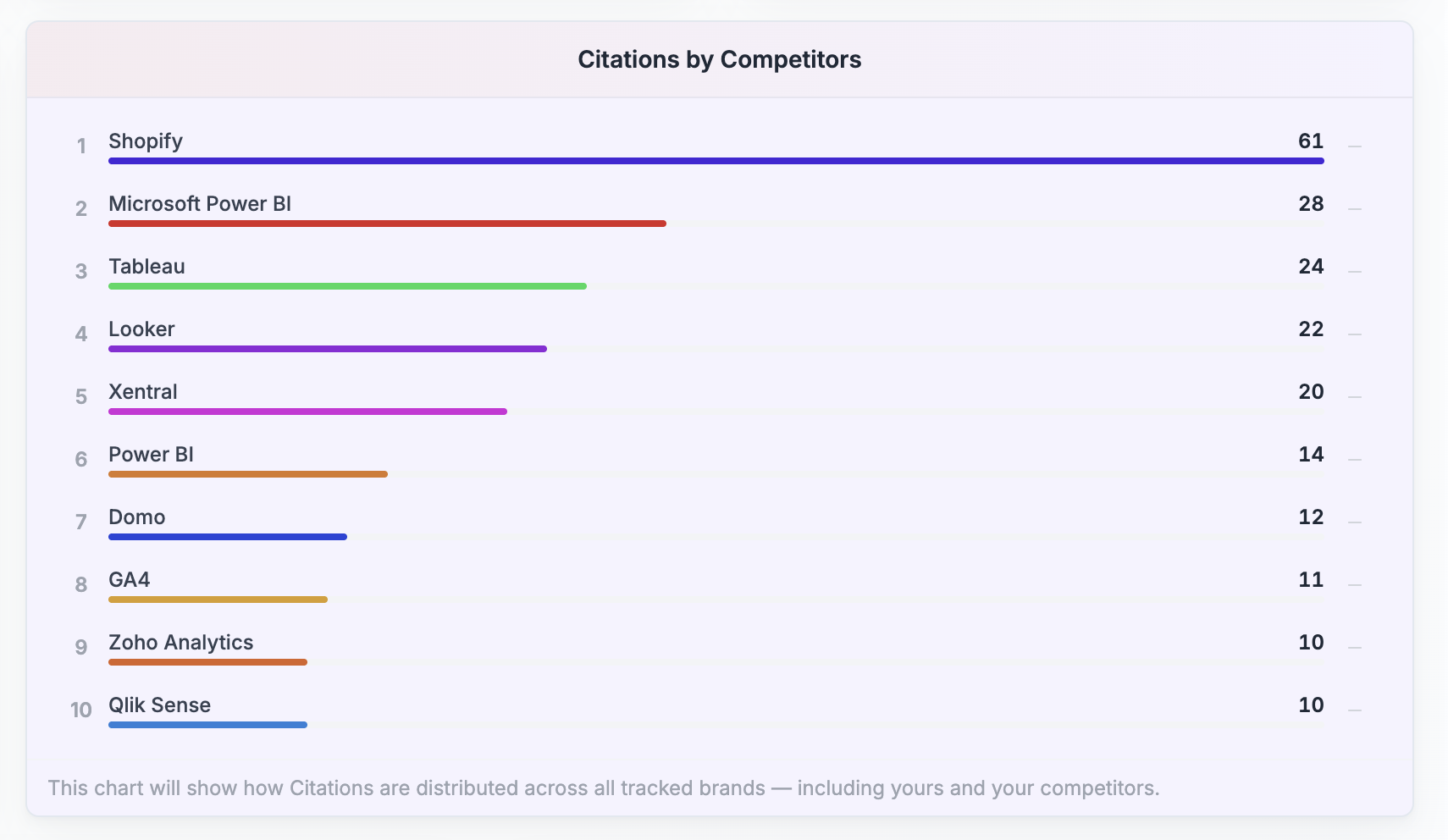
The structure is identical to the mentions list, only the metric changes. Important: The order often differs significantly from the mentions list.
In the same sample set, Shopify leads here too (61 citations), but the picture shifts behind it: Microsoft Power BI (28), Tableau (24), Looker (22), and Xentral (20). Brands like WooCommerce or Power BI appear differently in the citations list than in the mentions list because AI models rate them differently.
Mentions vs Citations as different stories
The two lists tell two different stories:
- Mentions measure awareness: Who gets mentioned in the category at all? Brands with high brand awareness and broad market penetration dominate here.
- Citations measure source authority: Which brands are recommended with evidence? Here, brands count whose content (or content about them) appears as a citable source in AI responses.
If a brand ranks high in mentions and low in citations, it has awareness but no strong source foundation. AI models mention it as a standard answer without actively backing it up.
If a brand ranks high in citations and low in mentions, it has a strong content or review position without the brand itself being dominant. This often happens with brands that regularly appear in listicles, comparison articles, or review platforms.
Identifying your own competitive set
Not all brands in these lists are real competitors. Often, related tools, parent platforms, or categories that get mentioned in AI answer contexts show up too.
- Make a mental note (or add it to your reporting) of the three to five brands that are your real competitors. Compare yourself primarily with those, not the entire list.
- Look for unusual brands in the lists: Sometimes it's worth understanding why a brand that isn't really a direct competitor gets mentioned so often (for example, because it's positioned as "the standard solution" in answers).
- If you're missing specific competitors, check in Show data table in the Brand Performance Chart whether they're being tracked at all.
Full brand table from Show data table
Both lists show only the top 10. The complete brand table is available in the Brand Performance Chart via Show data table.
In the full table, you'll see all tracked brands, often 30 or more. This is the place for deeper competitive analysis, for example if you want to know whether a specific niche brand in your set is showing movement.
Best Practices
Read the lists horizontally first, then vertically
- Problem: If you only look at the mentions list, you miss that the same competitor might paint a completely different picture in citations.
- How to: Take one competitor and compare its rank in both lists. Does it read the same or differently?
- Result: A differentiated view of your competitive situation, not just a flat list.
Actively look for rising stars
- Problem: Top competitors often move slowly. What's interesting are the brands that have appeared in recent weeks or climbed the rankings.
- How to: Regularly compare the lists with the status from two or three weeks ago (for example using the Previous period navigation and PDF exports).
- Result: You spot rising competitors early instead of noticing them only after they're already at the top.
Use the lists as a sales argument
- Problem: In pitches, "we're more visible than X" is often just a claim without evidence.
- How to: If your brand ranks above a direct competitor in the mentions or citations list, turn it into a slide for your pitch or QBR material.
- Result: Data-backed competitive arguments in sales conversations instead of anecdotal claims.
If you see a sudden jump for one of your competitors in either list (significantly more mentions or citations within two to three weeks), also check the Top Domains by Citations to see if new sources citing that competitor have appeared. Often there's a specific PR or content action behind it that you can learn from.
 Powered by happysupport.ai