
Top Domains & Top URLs by Citations
Identify which domains and URLs AI engines cite most frequently using the Top Domains and Top URLs tables to inform your SEO strategy
Which Sources AI Engines Cite in Your Category
While the lists Mentions by Competitors and Citations by Competitors show you which brands dominate in AI answers, the three tables below show you where those sources come from: which domains and URLs AI engines cite most frequently.
In this article, you'll learn how to read these tables and what insights they offer for your SEO, PR, and reviews strategy.
What You'll Find in This Article 👇
-
Top Domains by Citations
-
Top URLs by Citations
-
Understanding Domain Types
-
Reading Trends and Changes
-
Best Practices
Top Domains by Citations
The left table lists the most frequently cited websites in your current filter scope.
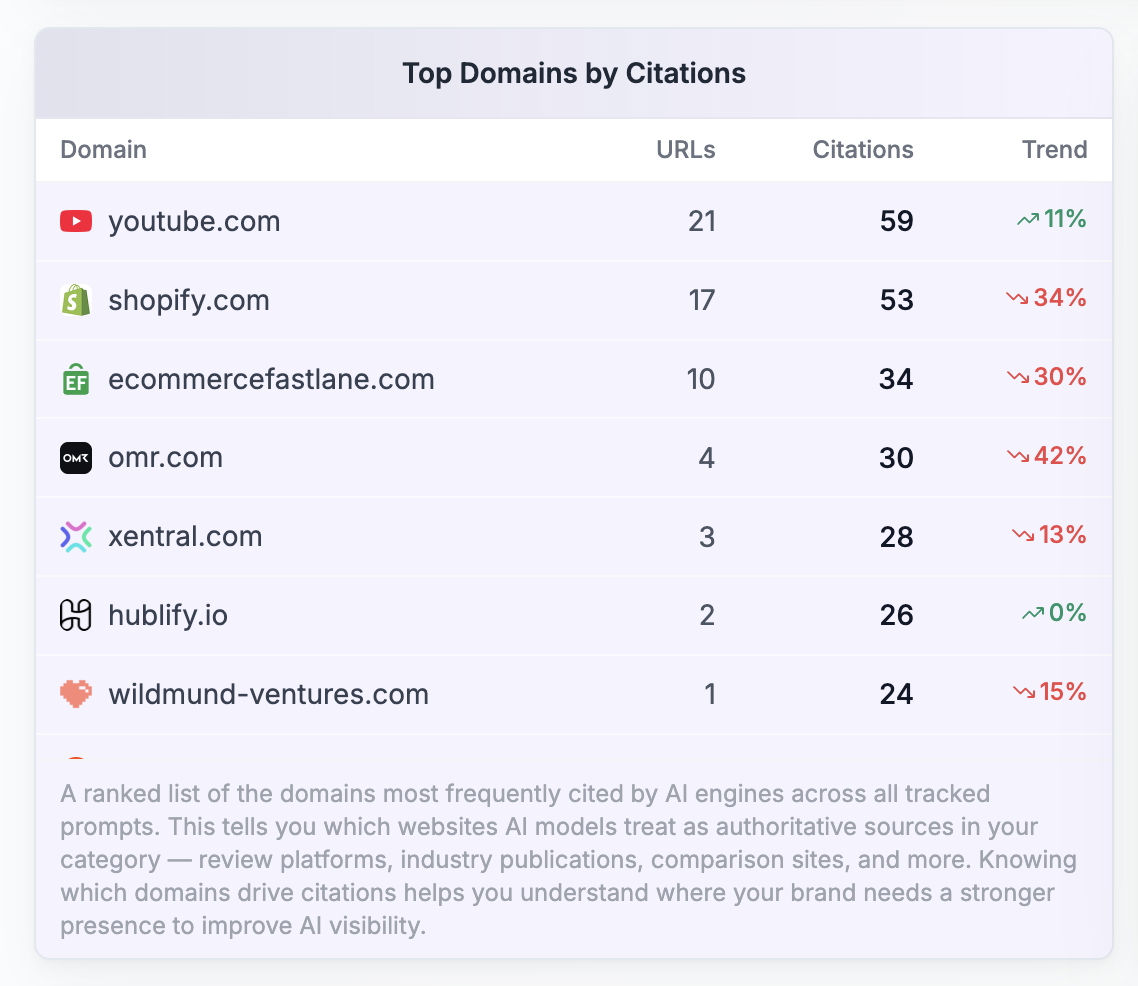
The table shows four columns:
- Domain with favicon for quick visual identification
- URLs: how many different URLs from this domain appear in AI answers
- Citations: total number of citations linking to this domain
- Trend: change compared to the comparison period, shown with ▲ green or ▼ red
In a real customer dataset, top domains might include youtube.com (21 URLs / 59 citations), shopify.com (17 URLs / 53 citations), ecommercefastlane.com (10 URLs / 34 citations), omr.com (4 URLs / 30 citations), xentral.com (3 URLs / 28 citations), hublify.io (2 URLs / 26 citations), and wildmund-ventures.com (1 URL / 24 citations).
omr.com regularly appears in the top citation domains because AI engines use OMR review profiles, listicles, and content hub articles as sources when making software recommendations.
Top URLs by Citations
The middle table shows the specific pages (URLs) that are cited most frequently.
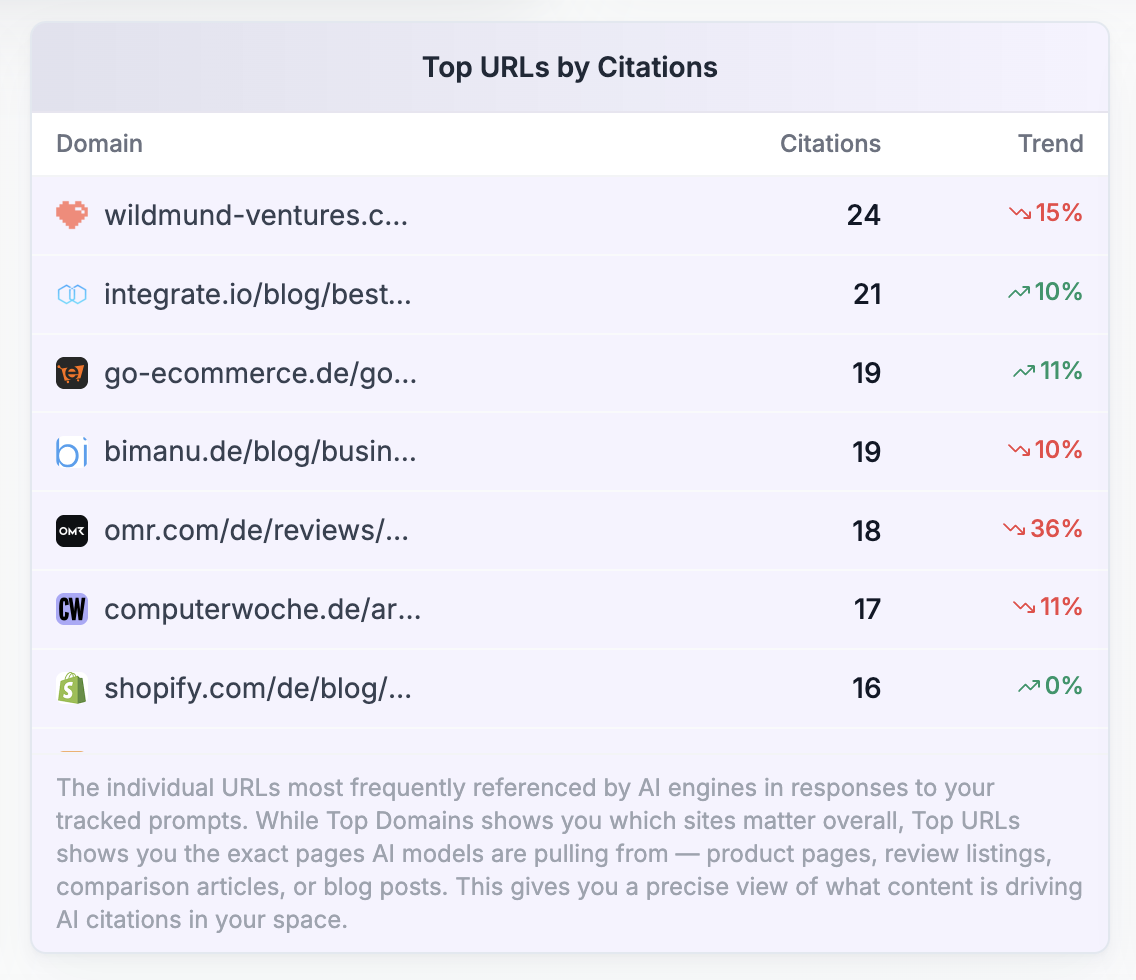
Columns:
- Domain as a column with the shortened URL (for example,
wildmund-ventures.c...) - Citations as an absolute number
- Trend with ▲ green or ▼ red
Examples include domain paths like wildmund-ventures.com/deckungsbeitrag-3-berechnen, integrate.io/blog/best-business-intelligence-tools-ecommerce, go-ecommerce.de/go-ecommerce-glossar/deckungsbeitrag, or omr.com/de/reviews/category/e-commerce-analytics.
- Look at the cited URLs directly in your browser. What kind of content is it? A listicle? A glossary? A comparison? A YouTube video?
- Ask yourself: Why exactly this page? Often, it's pages with clear structure (tool lists, "best of" articles, FAQ glossaries) that AI engines prefer as sources.
Understanding Domain Types
The cited domains can be grouped into three clusters:
- Review platforms and comparison sites like omr.com or Capterra-like providers that AI engines use as curated sources
- Industry publications and industry blogs like ecommercefastlane.com, computerwoche.de, or thedigitalprojectmanager.com that are cited as "best of" listicles or expert articles
- Brand domains within your set, meaning manufacturer sites like shopify.com, xentral.com, or wildmund-ventures.com that are cited for their own content pieces (glossaries, blog articles, tool pages)
Which cluster dominates in your case tells you something about the maturity level of your category in AI search:
- Dominant review platforms = buyers are looking for recommendations, AI uses curated lists.
- Dominant industry publications = buyers are researching expert articles, AI relies on editorial comparisons.
- Dominant individual brand domains = AI engines know individual brand content directly.
Reading Trends and Changes
The trend column shows which domains and URLs are gaining or losing ground. This is just as important as the absolute numbers because it reveals movement:
- Strongly rising domain = new source that AI engines cite more frequently. Question: What is this domain writing about lately?
- Strongly falling domain = former top source losing relevance. Question: Has the content changed or did another domain take over?
- New entry in the top 10 = a player just moved up. Worth taking a look at the cited URLs.
Best Practices
Always read domains together with URLs
- The problem: A top domain without URL context tells you little. youtube.com with 59 citations could be harmless (one video per brand) or a sign of a specific reviews-channel strategy from a competitor.
- How to do it: When a domain stands out, check the Top URLs by Citations to see which specific pages from this domain are running in your category.
- The result: Concrete content hypotheses instead of vague domain pictures.
Turn top URLs into a content research list
- The problem: The cited URLs are in the tool, but teams rarely work with them actively.
- How to do it: Copy the top 10 URLs once per quarter into a spreadsheet, look at each one individually, and note: What's the page type? Which brands does it mention? How is it structured?
- The result: A content research list you can use to develop your own content formats or plan PR outreach.
Track trend shifts as an early indicator
- The problem: When a previously dominant source loses ground, it eventually disappears from the top 10. By then, it's too late.
- How to do it: Note monthly which domains are in the top 10. Mark risers and fallers. React early if a domain where you're well-positioned drops.
- The result: You spot shifts in the source mix early and can proactively build new sources.
If you see omr.com among the top domains, that's a clear signal that your OMR review profile and OMR listicles are already providing citations for brands in your category. This directly suggests the lever to pull: actively expand your profile, collect reviews, get represented in listicles. Learn more in the article Best Practice: Citations as an SEO Lever.
 Powered by happysupport.ai