
OMR Score and Badges Explained
Understand how OMR Score and Badges use your average rating, review count, and recency to build trust and improve your software's visibility
How Ratings, OMR Score, and Badges Work Together
What You'll Find in This Article 👇
-
What OMR Reviews Badges Mean
-
Goals and Benefits of OMR Reviews Badges
-
What the OMR Score Means
-
Basics and Components of the OMR Score
-
Why Review Recency Matters
What OMR Reviews Badges Mean
The more positive reviews a tool gets, the better its chances of earning an OMR Reviews Badge.
Similar to a quality seal, badges show that a product or service is actively used by real users and receives positive feedback.
OMR Reviews Badges are recognized social proof elements and can be used effectively in your marketing mix to build trust with potential buyers and strengthen relationships with your existing customers.
Goals and Benefits of OMR Reviews Badges
✅ Build trust with potential customers
✅ Guide software seekers in their search
✅ Increase customer loyalty
✅ Strengthen brand image and credibility
✅ Boost visibility and competitiveness in the market
Not every tool automatically qualifies for an award. The badges are based on user ratings and satisfaction. To keep showing you the best tools, badges are reassigned quarterly based on different criteria.
Here you'll find detailed information about each OMR Reviews Badge and the criteria for earning one.
What the OMR Score Means
OMR Reviews created the OMR Score to rate software solutions based on user satisfaction within their categories.
The OMR Score categorizes software based on three factors: average rating, the number of published reviews, and how recent they are. The average rating carries the most weight.
The more reviews that go into the average rating, the more meaningful it becomes and the better it reflects the satisfaction of all users. That's why as the number of reviews increases, the statistical representativeness of the average goes up, while the importance of review quantity alone goes down.
A high OMR Score improves your ranking and visibility of a software solution within categories and serves as the basis for earning the Leader Badge, which recognizes the top-ranked solution in a category by OMR Score.
A good ranking typically brings more profile traffic and increases your visibility within the category. The resulting profile visits can provide additional insights into interested companies (buyer intent data) and serve as a data-driven foundation to better understand potential buying intentions and target relevant accounts more effectively.
Basics and Components of the OMR Score
The OMR Score is based on three main components:
1. Number of Reviews
The more reviews a software receives in a category, the more likely it is that the average rating accurately reflects user satisfaction for that category or use case.
Especially when there are few reviews, the number of reviews has a major impact on the OMR Score. With a higher number of reviews, the rating becomes statistically more representative, which means the average rating and customer satisfaction carry more weight, while the importance of review quantity alone decreases.
2. Average Rating
Besides the number of reviews, user satisfaction also goes into the OMR Score. This is determined using the NPS Score (Net Promoter Score), where users rate on a scale of 0 to 10 how likely they are to recommend a software. The NPS Score is averaged for easier display on the OMR Reviews platform and shown on a 5-star scale. A high average indicates a strong likelihood of recommendation, while a lower score signals room for improvement.
3. Review Recency
The OMR Score also takes into account the recency of each review alongside the number and satisfaction level. Reviews older than one year are weighted with a lower factor in the calculation to ensure the score prioritizes the most current and relevant information. This weighting allows software seekers to get an accurate, up-to-date assessment of a product's current performance and functionality.
Why Review Recency Matters
How relevant and meaningful a review is depends heavily on how recent it is. Since technologies and software solutions constantly evolve, current reviews provide a more precise and realistic picture of what a tool can do. They reflect the latest user experiences and inform you about product updates, new or improved features, and potential challenges. For users, this information is especially valuable because they can make informed decisions based on a software's current capabilities.
An analysis by G2 shows that review recency is crucial for potential buyers: 66% of buyers prefer reviews that are no more than three months old. Additionally, 61% trust a product more when it has between 11 and 50 reviews. These numbers show how important it is to regularly collect new reviews to gain and maintain buyer trust, even when you already have plenty of positive feedback.
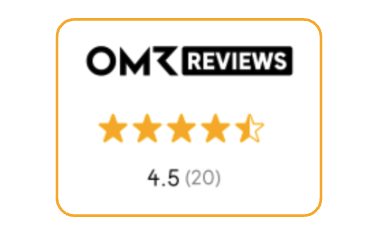
How Your Average Rating Appears in the OMR Reviews Score Widget
The OMR Reviews Score Widget displays your average rating (5-star scale) and number of reviews in real time. As an effective social proof element on your website, it builds trust with potential and existing customers. In our article "OMR Reviews Score Widget" you'll learn how to get and use the widget.
 -4)
-4)
OMR Reviews Score Widget
 Powered by happysupport.ai